
Whenever we hear about building connections, it is with our partner, with our family, with our friends, or sometimes with our coworkers. However, there is a certain relationship which silently governs all other relationships.
What happens when you don’t have a relationship with yourself?
You are constantly seeking approval, doubting yourself, ignoring your needs, having difficulties establishing boundaries, being emotionally drained, yet not knowing why. You might even observe that all your relationships, career, self-confidence and overall way of living becomes challenging.
That is why building an emotional connection with yourself is crucial.
As a Relationship Coach, Sangeeta Sharma looks at relationships differently. She considers relationships from a broader perspective. Not just as relationships between two people, but also as your relationship with yourself.
And once you start restoring the connection with yourself, everything else starts changing as well.

What Does Emotional Connection With Yourself Mean?
Self-emotional connection involves the ability to recognize, acknowledge and react to your emotions, feelings, needs and thoughts.
This involves asking yourself questions like:
- How do I really feel?
- What do I need at this moment?
- Why is this bothering me so much?
- Do I do this because I really want to or just to seek approval from others?
- Do I respect my own limits?
- Do I think that I deserve respect and love?
An emotionally connected individual is not necessarily a happy person all the time.
It is about being honest with yourself without judging yourself.
Why Does Your Relationship With Yourself Matter So Much?
Look at yourself as the bedrock of your existence.
Your connections, career, lifestyle, actions, self-esteem, and emotional state are all established upon this bedrock.
When there is negativity in your relationship with yourself, such as self-criticism, insecurity, fear, and repressed emotions, it will affect all aspects of your life.

You will:
- Settle for relationships where you are not treated with respect.
- Miss out on possibilities because you don’t think you are good enough.
- Compare yourself constantly to others.
- Feel guilty whenever you put yourself first.
- Struggle with saying no.
- Develop an unhealthy dependence on the affirmation from external sources.
- Be burdened by emotional exhaustion.
On the other hand, when you have cultivated self-worth and respect as well as emotional maturity, you start seeing your world from another point of view.
You speak with clarity, make better decisions, know where your limits lie.
You don’t need to look outside yourself for continuous approval of your worth.
Self-Love Is More Than Saying Positive Things
There are many misconceptions about self-love.
Self-love isn’t about looking in the mirror and saying, “I’m awesome.”
True self-love involves things such as:
- Resting when you’re tired.
- Getting out of places that consistently hurt you.
- Forgiving yourself for your past actions.
- Honor your boundaries.
- Letting yourself change without expecting perfection.
- Talking to yourself in the same way that you talk to others.
Here’s where the concept of self-worth comes into play.
Once you know how valuable you are, you realize that you don’t need to prove anything to anyone in order to earn love, respect, success, and happiness.

How Emotional Disconnection Can Affect Your Daily Life
An absence of connection within yourself isn’t something that stays confined to just feelings.
It affects everything about one’s life from how they lead their life to the decisions they make at work.
Take, for instance, a person who always questions their own worth and, because of this, might not be able to voice their opinion at work. Or someone who is afraid of being rejected and might end up tolerating bad behavior from others in relationships.
That is why personal development goes hand-in-hand with life.
Inner Healing: Going Beyond the Surface
Many times, the very reason that makes you unable to love yourself now has nothing to do with your current situation.
Previous experiences, past criticisms, rejections, unmet emotional needs, and other challenging life experiences could make you have a certain perception about yourself.
Here comes the role of inner healing which could help you in growing.
Inner healing means making room for recognizing past emotional patterns rather than just trying to avoid or suppress them.
You may start asking:
“Am I always feeling inadequate?”
“Why am I fearful of letting others down?”
“Why am I unable to accept any praise?”
“Why do I always prioritize other people’s needs above my own?”

A Simple Example of Rebuilding Self-Connection
This is the story of Riya. (Name Changed)
Riya was there for everyone. She took care of her family, helped her friends, did well in her career, and hardly ever said no.
On the outside, she appeared self-assured and compassionate.
However, on the inside, she was always feeling emotionally drained.
When she wanted to take care of herself, she felt guilty.
With help of self-growth practices, she gradually understood that she had attached her self-worth to being needed by others.
Rather than wondering “Am I going to satisfy everyone?”, she started wondering:
“Is this good and appropriate for me?”
She set some boundaries, listened to her emotions, found time for herself, and understood that saying no would not make her a terrible person.
Her circumstances were not instantly changed.
However, her relationship with herself got better.
As her relationship with herself improved, she noticed how differently she began communicating, working, dealing with difficulties, and interacting with others.
This is how reconnecting with yourself works.
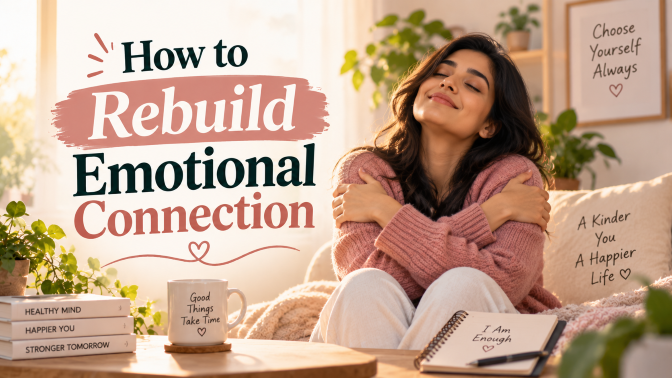
7 Ways to Rebuild Your Emotional Connection With Yourself
| 1. Begin Tuning into Your Emotions Do not shut down uncomfortable emotions. Instead of doing so when you are feeling angry, upset, anxious, or overwhelmed, try asking yourself this question: “What message does this emotion bring?” Sometimes emotions hold important information about your needs, boundaries, and experiences. | 2. Begin Practicing Self-Compassion Pay attention to how you talk to yourself. Would you talk to your closest friend this way after a mistake? Then change this negative inner voice. |
| 3. Begin Practicing Healthy Boundaries Remember that boundaries are not the same thing as walls. They serve as communication about things you are comfortable with and those that make you uncomfortable. Setting healthy boundaries can help improve your relationship with yourself because your needs matter as well. | 4. Stop Valuing Yourself Through Others You should understand that your worth is not dependent on anyone’s approval, attention, success, or opinion. The more you value yourself externally, the less internally you will be able to feel secure. |
| 5. Be in Quiet Company with Yourself Not all times require distraction or entertainment. Take some time to reflect on your thoughts by journaling, walking, reading, and contemplating. Self-awareness requires presence. | 6. Deal with Your Emotions If there are emotions that keep cropping up, try examining why by reaching out for the necessary help. Techniques like inner child healing, emotional healing, life coaching, etc., might assist in understanding the patterns and adopting a healthier response. |
| 7. Keep Your Own Word If you keep making promises of taking care of yourself but never follow up on them, your ability to trust yourself will diminish. Start small. If you promise yourself 20 minutes of quiet time, take it. When you set a boundary, respect it. By doing so, you reaffirm the connection you have with yourself. |
How Coach Sangeeta Sharma Helps You Look Within
According to Coach Sangeeta Sharma, any kind of transformation should start from the process of self-understanding.
Her experience as a relationship coach and life coach does not limit itself to enhancing interpersonal relationships.
Instead, her work is based on the process of working with yourself, your self-respect, your emotional patterns, mentality, inner healing and self-growth.
It’s quite a simple idea:
When the relationship with yourself starts improving, then everything else may begin to change as well.
You do not have to change who you are.
You just need to come back to yourself.

Final Thoughts
Before asking yourself, “How do I repair my relationship with others?,” there are times when a more essential question is actually:
“Where does my relationship stand with myself?”
Do you listen to yourself?
Do you have respect for yourself?
Do you take time to relax?
Do you think you deserve it?
Do you forgive yourself?
Do you feel secure being yourself?
The relationship that you have with yourself will affect how you perceive the world around you.
As you start to heal inside and build up self-worth and emotional connections with yourself, your outer world will start to change as well.
Your quest for improved relationships might just start with the most crucial relationship of all the relationships that you have with yourself.
Begin your self transformation journey with Self Transformation Coach Sangeeta. Book a free strategy session today!