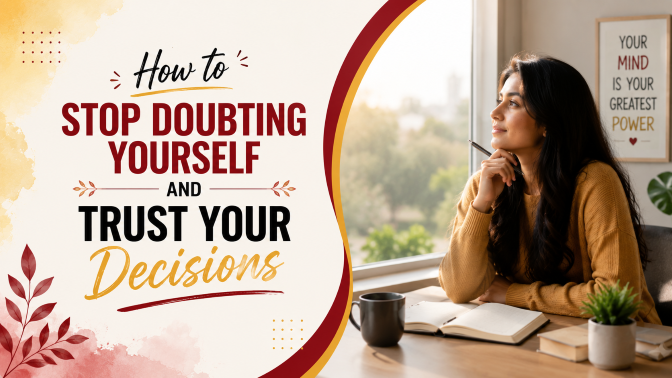

Have you ever made a decision but started wondering about it immediately?
You decide on your career but start to question yourself, why you did not take some other course instead. You decide to break up with someone, but you cannot stop wondering if you made the right decision. Decisions do not become easy if your mind keeps on saying, “What if I am wrong?”
Self-doubt can be a silent destroyer of every aspect of your life. Self-doubt can lead you to second guess yourself, need assurance at every step, live in the fear of making a mistake, and delay decisions which actually mean something for you. The reason for this is usually not that you are unable to make good decisions. It is simply that you do not trust yourself anymore.
The best part is that it can all be fixed.
With enough awareness, life coaching, mindset coaching, emotional healing, and self transformation, self-doubt can easily be overcome.
Why Do We Doubt Our Decisions?
Doubt in oneself usually doesn’t occur without any reason. Doubt in oneself may form because of prior experiences, being criticized, fear of failure, comparisons, or situations where one’s choices have been constantly doubted.

Here are some typical reasons for doubt in oneself:
- Fear of choosing wrong
- Overthinking each and every outcome
- Past mistakes affecting current decisions
- Desire to please others
- Lack of confidence and self-respect
- Perfectionism
- Fear of disappointing others
- Unresolved emotional experiences
- Problems with trusting oneself
In many cases, the actual decision one faces isn’t always the main issue. The emotional reaction one feels when making that decision might be related to something very deep.
The Connection Between Past Experiences and Self-Doubt

Think of a person who had been constantly told as a child, “You can’t do this”, “You always do the wrong thing” or “Allow others to choose for you.”
After all these years have passed, he or she might keep seeking confirmation from outside.
Here is when inner child healing may become an essential element of your development process. Through identifying the unprocessed emotional patterns, you can realize what makes you feel afraid, insecure or indecisive at times.
In addition to that, for some people, techniques like past life regression can be considered within their personal or spiritual healing process. Such techniques should not be regarded as definitive explanations of the current events in your life.
Instead of that, you should not feel guilty about your past. You should try to get to know yourself better so that your past could no longer dictate your present.
A Client Story: When Every Decision Felt Wrong
Neha was a highly successful professional but always lacked self-trust. Prior to taking even the most trivial decisions in her life, she used to seek advice from her friends and relatives. Once she made the decision, she used to ponder over and wonder whether she should have taken other people’s suggestions.
In the course of her personal growth, she started working on her mindset and emotional patterns through coaching.
Instead of asking “What if I take a wrong decision?”, she began asking herself questions like:
“What is the information that I have? What do I really want and what is the decision in tune with my values?”
Neha gained confidence in dealing with uncertainties. She understood that self-trust does not always mean being sure about what will happen but it involves being confident in handling the outcome and learning from her experience.
This is one of the essential aspects of self-transformation.
7 Ways to Stop Doubting Yourself
| 1. Stop Looking for Perfect Decisions The truth is there is rarely a decision where the outcome is guaranteed with 100% certainty. Rather than waiting for certainty, make the best possible decision given the information you have at the time. Even if a good decision doesn’t yield the expected outcome, it does not necessarily make it a bad decision. | 2. Distill Facts From Your Fears In case you feel lost and overwhelmed, take a sheet of paper and divide it into two columns: Facts: What do I know for sure? Fears: What do I imagine could possibly happen? Sometimes, this seemingly silly exercise will help you realize the difference between intuition and fear trying to think of all worst-case scenarios. |
| 3. Start Listening to Yourself Ask yourself: What do I really want? What’s important to me? Am I doing it out of genuine interest or craving for approval? What would be my decision if it were not for fear of being judged? Which one is in line with my values? | 4. Stop Seeking Validation from Everybody Seeking advice is useful; however, relying on others too much for decisions might undermine your self-confidence. Instead of asking another person what to do right away, try asking yourself first. One does not need to surrender their freedom of choice when listening to other points of view. |
| 5. Take Small Decisions Without Excessive Thinking Learning to trust oneself takes time and requires practice. Begin with making little decisions. You can decide about your daily routine, priorities, something new to learn, and how to use your time without constantly checking with other people whether it is okay. Each time you make an intentional decision and stick to its consequences, you teach yourself: “I am able to trust myself.” | 6. Learn About Your Emotional Triggers When some decisions make you feel very scared, ask yourself why such fear arises. Sometimes, current life situations can trigger old emotional mechanisms. Consultation with a specialist via emotional healing or coaching can help you deal with such issues. |
| issues. 7. Accept that Mistakes are Inevitable Self-confidence isn’t achieved through avoiding mistakes. It’s about knowing that: “Even if I commit a mistake, I can cope with it.” As soon as you cease to panic about each mistake, decision-making is much easier. |
How Life Coaching Can Help You Build Self-Trust

A great coach never tells you which decision to take.
Life Coaching helps to find out the limiting beliefs, recognize the patterns and set new goals and practical steps towards achieving those goals.
Best Life Coach, Sangeeta Sharma is all about personal growth and transformation by exploring the emotional and mental patterns that hold someone back.
With mindset coaching, reflection and personal growth, one may change their approach from:
“What if I choose the wrong path?”
to:
“I trust my ability to make a wise decision and deal with the consequences of my decision.”
This change will surely have an impact in personal as well as professional life.
Self-Trust Is a Skill You Can Develop
You won’t wake up in the morning with full trust.
Self-trust is something that you have to gain through experience and awareness.
It comes through:
- Keeping the promises you make to yourself
- Having healthy boundaries
- Making decisions based on what you believe
- Learning from mistakes
- Not constantly comparing yourself to others
- Being aware of your own emotional responses
- Being responsible for your actions
- Allowing yourself to grow
- You aren’t trying to get rid of all the doubt.
- You are trying not to let it control every decision you make.
Final Thoughts
But if you find yourself second guessing all the time, keep in mind that it might not all be about being “indecisive” at all! Your thought processes, experiences, emotions, beliefs, and fears could all be playing a part in how you decide on things.
With increased clarity and emotional awareness, as well as the appropriate guidance and support, you can start transforming these processes.
Transformation starts when you stop waiting for others to tell you that you’re ready—and when you come to believe that you’re able to find your own path.
Book your FREE Strategy Session with the BEST Life Coach in India – Sangeeta Sharma.
Frequently Asked Questions
The reasons for self-doubt might be a fear of failing, bad experiences, perfectionism, lack of confidence, criticism, or need for constant external validation.
You need to gather the necessary information, identify your values, listen to your point of view, and accept that every decision has a risk of uncertainty.
Yes, always thinking about every single possible outcome will make the process of even the most ordinary decision making very complicated and hard for yourself.
It will help you identify limiting beliefs, figure out your goals, find out how you think, and apply certain techniques to make decisions easier for yourself.
It is a process of identification of problematic thought patterns and their substitution with more constructive ones.
It is a reflective technique that aims at understanding your unresolved issues and experiences from the past that affect the present.
Yes. Past criticisms, failures, rejections, and other negative experiences might have some impact on your personal views about yourself and your level of self-confidence.
Past life regression is a technique of looking into past life experiences by interpreting experiences as memories of one’s previous life. It is worth approaching it rationally and not as proven scientifically that it has to do with people’s past lives.
Emotional healing includes recognizing your feelings and patterns in response to events. Emotional healing will help you react to what is happening in the present moment without repeating the old patterns of reactions.
There is no exact period of time. It is individual and depends on each person.
Confidence tends to be connected to the idea of being able to accomplish something. Self-trust means that you believe that you can make good decisions, deal with situations, and learn from anything that comes your way.
In case overthinking, lack of confidence, indecisiveness, or habitual patterns hinder your progress towards achieving your goals, it might be helpful for you to get help from a professional coach.